


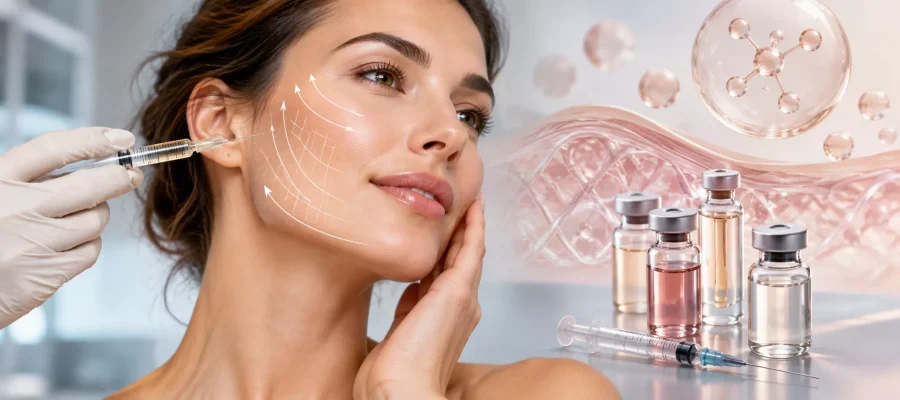
Biostimulators are a group of treatments used to support collagen production in the skin and improve age-related tissue changes. They may be considered particularly in non-surgical facial rejuvenation approaches known as liquid facelifts, with the aim of improving skin quality and restoring lost facial support. However, not all biostimulators contain the same active ingredient, and not every product is designed to achieve the same result. There are important differences between collagen-stimulating products such as Ellansé, Radiesse, Facetem, and Sculptra and polynucleotide-based treatments such as Nucleofill and Rejuran. Some focus on facial volume and structural support, while others aim to improve skin texture, quality, and elasticity. Understanding these differences is essential for knowing what each product does and which skin concerns it may be considered for.
What Are Biostimulators and What Do They Do?
Biostimulator is a general term for products intended to support collagen production or tissue renewal by influencing the skin’s own biological processes. In aesthetic dermatology, injectable products known as collagen stimulators make up a significant part of this group. Collagen is one of the main proteins responsible for the skin’s strength and structural integrity. As we age, reduced collagen production is associated with changes such as loss of elasticity, wrinkles, and weakened tissue support. The purpose of biostimulator treatments is not simply to fill existing spaces with a filler. Some products may support the formation of new collagen by influencing the activity of cells called fibroblasts. This process is known as neocollagenesis. However, biostimulator is a broad term. Collagen-stimulating fillers containing calcium hydroxyapatite, poly-L-lactic acid, or polycaprolactone and polynucleotide-based skin rejuvenation products are sometimes grouped together, even though their mechanisms of action differ.
What Is a Liquid Facelift?
A liquid facelift is a general term for addressing changes in facial volume, contours, and skin quality through injections without surgery. It is not the name of a single product or a standardized treatment. Facial aging involves more than the appearance of wrinkles. Loss of cheek volume, reduced jawline definition, deepening nasolabial folds, and decreased skin elasticity may occur together. A non-surgical liquid facelift approach involves evaluating the causes of these changes. In some individuals, restoring volume is the priority, while in others, improving skin quality may be the main goal. Depending on the product selected and the injection technique, biostimulatory fillers may provide structural support and stimulate collagen production. However, injectable treatments are not equivalent to a surgical facelift. Results may be limited, particularly in cases of advanced skin sagging.
What Active Ingredients Are Used in Biostimulators?
One of the main differences between biostimulator products lies in their ingredients. Calcium hydroxyapatite, poly-L-lactic acid, polycaprolactone, and polynucleotides act through different biological mechanisms.
What Is Calcium Hydroxyapatite (CaHA)?
Calcium hydroxyapatite is a synthetic form of a biocompatible mineral structure that has been used in medicine for many years. In aesthetic treatments, it may be present as microspheres suspended in a carrier gel. Depending on their formulation and application technique, CaHA-containing products may provide initial volume support to the tissue. Over time, biological processes that support new collagen formation may develop around the microspheres. Radiesse and Facetem are examples of biostimulatory fillers containing calcium hydroxyapatite. However, sharing the same active ingredient does not mean that these products have identical properties.
What Is Poly-L-Lactic Acid (PLLA)?
Poly-L-lactic acid is a biodegradable synthetic polymer. In aesthetic dermatology, it is particularly associated with treatments that gradually support collagen production. Rather than creating immediate, permanent filler volume, PLLA aims to encourage the tissue to produce collagen over time. Consequently, results generally become noticeable in stages. Sculptra is one of the collagen stimulators containing poly-L-lactic acid. It may be considered in individuals experiencing age-related volume loss and reduced tissue support.
What Is Polycaprolactone (PCL)?
Polycaprolactone is a biodegradable synthetic polymer. It is used in microsphere form in certain dermal filler products. PCL-based biostimulatory products may combine the initial volume provided by a carrier gel with longer-lasting tissue support that can develop through collagen stimulation. Ellansé is one of the polycaprolactone-based products. However, treatment outcomes depend not only on the active ingredient but also on the product formulation, treatment area, and individual tissue characteristics.
What Are Polynucleotides (PN)?
Polynucleotides are biological molecules made up of building blocks called nucleotides. In aesthetic dermatology, they are being studied particularly for their potential to support skin quality, hydration balance, and tissue renewal. Nucleofill and Rejuran are among the polynucleotide-based products. Their primary aim is generally to improve the skin’s textural characteristics. The terms polynucleotide (PN) and polydeoxyribonucleotide (PDRN) are sometimes used together. However, the molecular structures, chain lengths, and formulations of the products may differ. Another important distinction is that polynucleotide treatments are not directly equivalent to structural collagen stimulators containing CaHA or PLLA.
What Is Ellansé and What Does It Do?
Ellansé is a biostimulatory filler containing polycaprolactone (PCL) microspheres and a carrier gel. It was developed to address age-related volume loss and support collagen production. The product’s carrier gel may provide an initial volumizing effect. Over time, the polycaprolactone microspheres interact with the tissue, creating a framework that supports new collagen formation. This feature distinguishes Ellansé from some fillers that only add volume. However, the degree of change may vary depending on the injection technique and individual characteristics. Long-lasting collagen-stimulating fillers such as Ellansé require careful selection. The product cannot be routinely dissolved using hyaluronidase, the enzyme used for hyaluronic acid fillers. Therefore, dermatological assessment and product selection before treatment are particularly important.
What Is Radiesse and What Does It Do?
Radiesse is a biostimulatory filler containing calcium hydroxyapatite (CaHA) microspheres. It is used in aesthetic dermatology because it can provide tissue support while also stimulating collagen production. The carrier gel in Radiesse may provide initial volume when appropriately administered. CaHA microspheres may also influence fibroblast activity and changes in the skin’s extracellular matrix. The treatment approach may differ depending on whether the goal is to strengthen the face’s structural support or improve skin quality. However, the treatment area, injection depth, and product preparation are not the same for every patient. Research on Radiesse has reported tissue changes associated with collagen and elasticity. Nevertheless, the same degree of tightening or volume improvement should not be expected in every individual.
What Is Facetem and How Is It Different from Radiesse?
Facetem is another collagen-stimulating filler containing calcium hydroxyapatite. The Facetem-S formulation, in particular, is characterized by the structure of its CaHA microspheres and the properties of its carrier gel. The main purpose of Facetem is to provide tissue support at the treatment site and promote collagen formation. In this respect, it follows a biostimulation approach similar to Radiesse. The main difference between Radiesse and Facetem is that, although they belong to the same active-ingredient family, their microsphere structures, manufacturing technologies, and product characteristics differ. Facetem particularly emphasizes a lattice-like, porous microsphere structure. However, strong head-to-head clinical studies are needed to establish that one product is definitively more effective or safer than the other. Therefore, ranking them solely by brand name would not be appropriate.
What Is Sculptra and What Does It Do?
Sculptra is a collagen stimulator containing poly-L-lactic acid (PLLA). The product is sometimes written as Sculptura, but its correct brand name is Sculptra. A key characteristic of Sculptra is that results develop over time as collagen is produced. In this respect, it differs from certain fillers that provide noticeable volume immediately. PLLA particles may stimulate collagen production through controlled biological processes in the tissue. As a result, changes in skin support and the appearance of age-related volume loss may develop gradually. Clinical studies on Sculptra liquid facelift treatments have reported that some effects may persist for an extended period. However, the number of sessions, the time required for results to appear, and their longevity vary between individuals. Injecting the product into inappropriate tissue layers or using an incorrect technique can cause complications such as nodule formation.
What Is Nucleofill and What Does It Do?
Nucleofill belongs to the group of polynucleotide-based skin rejuvenation products. The product range includes formulations with different concentrations and characteristics. The main goal of Nucleofill treatments is to support skin hydration, elasticity, and textural quality. The water-retaining properties of polynucleotides and their potential effects on tissue renewal are being investigated in this field. However, Nucleofill should not be evaluated in the same way as a traditional filler designed to create noticeable facial volume. Improving skin quality and providing structural volume to facial contours are different treatment goals. Although there are encouraging clinical findings regarding polynucleotide treatments, further research is needed to establish ideal protocols, long-term effectiveness, and comparative outcomes between products.
What Is Rejuran and What Does It Do?
Rejuran is a range of skin rejuvenation products containing polynucleotides (PN). It is particularly associated with treatments intended to support skin texture and elasticity. The polynucleotides used in Rejuran products are obtained from purified fish-derived DNA components. The product range includes formulations developed for different treatment objectives. Uneven skin texture, fine lines, and loss of elasticity are among the concerns being studied in relation to polynucleotide treatments. However, the extent and duration of these effects may vary according to individual characteristics. Rejuran should not be confused with structural fillers intended to produce significant facial reshaping. Its primary focus is improving skin quality.
Differences Between Ellansé, Radiesse, Facetem, Sculptra, Nucleofill, and Rejuran
The most important differences between these six products are their active ingredients and intended biological effects.
| Product | Active ingredient | Primary approach | General characteristics of the effect |
| Ellansé | Polycaprolactone (PCL) | Volume support and collagen stimulation | Initial volume and gradual changes |
| Radiesse | Calcium hydroxyapatite (CaHA) | Tissue support and collagen stimulation | Volume and tissue effects vary by product and technique |
| Facetem | Calcium hydroxyapatite (CaHA) | Structural support and collagen stimulation | Initial support and gradual changes |
| Sculptra | Poly-L-lactic acid (PLLA) | Supporting gradual collagen production | Effects develop over time |
| Nucleofill | Polynucleotide-based ingredients | Skin quality and hydration support | Generally gradual changes in skin texture |
| Rejuran | Polynucleotides (PN) | Supporting skin quality | Generally gradual changes in skin texture |
The classification in the table summarizes each product’s primary approach. Formulation and usage characteristics may differ even between products with the same active ingredient. An important distinction exists between Nucleofill and Rejuran on one hand and Ellansé, Radiesse, Facetem, and Sculptra on the other. The first two are primarily associated with polynucleotide-based skin-quality treatments. The other four are considered in relation to structural tissue support or collagen stimulation.
What Is the Difference Between Biostimulatory Fillers and Hyaluronic Acid Fillers?
Biostimulatory fillers and hyaluronic acid fillers work through different mechanisms. The main goal of hyaluronic acid filler treatments is usually to provide volume support and shape specific anatomical areas. Depending on the substance used, biostimulatory fillers may also support collagen production over time in addition to providing initial volume. Gradually developing tissue changes are particularly important in PLLA-based treatments. Another significant difference is reversibility. Hyaluronic acid fillers can be dissolved with the enzyme hyaluronidase in certain circumstances. There is no equivalent standard dissolving method for products containing CaHA, PLLA, or PCL. For this reason, product selection should take into account not only the desired aesthetic outcome but also treatment safety and the management of potential complications.
Which Biostimulator May Be Considered for Different Skin Concerns?
Choosing a biostimulator begins with identifying which aspect of the skin or facial structure needs to be addressed. Volume loss, reduced elasticity, and changes in facial contours are not the same concern. In individuals with noticeable cheek volume loss, treatments that provide structural support, such as fillers for hollow cheeks or midface filler, may also be considered during the assessment. However, the appropriate treatment depends on the individual’s anatomical characteristics.
| Skin concern | Potential treatment approach |
| Facial volume loss | Suitable structural fillers and collagen stimulators |
| Loss of tissue support associated with declining collagen | CaHA-, PLLA-, or PCL-based treatments |
| Dullness and reduced skin-texture quality | Polynucleotide-based skin rejuvenation approaches |
| Fine lines and reduced elasticity | Different injectable and dermatological treatments depending on the cause |
| Pronounced skin sagging | Assessment of different treatment options, including surgery |
This table is not a treatment prescription. The same concern can have different underlying causes in different individuals. A dermatological examination is therefore required to determine the appropriate product.
When Do Biostimulator Treatments Start Working?
The time it takes for biostimulators to produce effects varies according to the ingredient used and the treatment objective. Some products may create an initial difference in volume because of their carrier gel. Changes associated with collagen production may take longer to develop. Gradual results are particularly expected with poly-L-lactic acid-based treatments. With products containing calcium hydroxyapatite or polycaprolactone, initial support and subsequent biological changes may emerge at different times. Changes in skin quality following polynucleotide-based treatments may also be assessed over time. However, there is no single onset time or duration of effect that applies to every product. The longevity of results may be affected by the person’s age, skin structure, injection technique, and the characteristics of the product used.
Are Biostimulator and Liquid Facelift Treatments Safe?
Biostimulator injections are medical procedures and carry certain risks. The most common side effects include pain, swelling, redness, bruising, and tenderness at the injection site. With some products, delayed nodules, firmness, or granulomas may develop. Accidental injection of filler material into a blood vessel can lead to rare but serious complications. These risks include tissue damage, vision loss, and other vascular problems. For this reason, the anatomy of the treatment area, the person’s previous filler procedures, and their medical history must be carefully evaluated. Active infections, certain allergies, and some medical conditions may affect the treatment decision. Unexpected severe pain, blanching or discoloration of the skin, or changes in vision after an injection require emergency medical assessment.
Why Is a Dermatologist’s Assessment Important When Choosing a Biostimulator?
A biostimulator should not be selected solely on the basis of its brand name. The facial anatomy, skin quality, degree of volume loss, and the individual’s expectations must first be evaluated. For example, a person with fine lines may have different needs from someone with significant cheek volume loss. The methods considered for wrinkle treatment do not necessarily have the same goals as treatments intended to restore lost volume. Likewise, reduced elasticity and advanced skin sagging should not be approached in the same way. During a dermatological assessment, the product’s active ingredient, suitability for the treatment area, safety profile, and the person’s medical history are reviewed together. This allows an approach tailored to the actual need to be planned while avoiding unnecessary procedures.
Frequently Asked Questions About Biostimulators and Liquid Facelifts
What is a biostimulator?
A biostimulator is a product intended to support biological processes in the skin, such as collagen production or tissue renewal. Fillers containing CaHA, PLLA, and PCL are among the main collagen stimulators.
Does a liquid facelift actually lift the face?
A liquid facelift may improve the appearance of facial volume and contours in suitable patients. However, it does not provide the tissue-lifting effect of a surgical facelift. Its results are limited in cases of advanced sagging.
Are Radiesse and Facetem the same product?
No. Radiesse and Facetem are different commercial products containing calcium hydroxyapatite. Although they belong to the same active-ingredient family, their microsphere structures and formulation characteristics may differ.
What is the difference between Ellansé and Sculptra?
Ellansé contains polycaprolactone, whereas Sculptra contains poly-L-lactic acid. The carrier gel in Ellansé may provide initial volume, while Sculptra is primarily associated with gradual collagen stimulation.
Does Sculptra increase collagen production?
The poly-L-lactic acid in Sculptra may stimulate biological processes that support collagen production. Its effects generally develop over time, and results vary between individuals.
What is the difference between Nucleofill and Rejuran?
Nucleofill and Rejuran are both polynucleotide-based product ranges. However, their manufacturing processes, molecular characteristics, concentrations, and formulations may differ. There is insufficient comparative evidence to demonstrate that one is definitively superior to the other.
Are polynucleotides and calcium hydroxyapatite the same thing?
No. Polynucleotides are biological molecules studied primarily for skin-quality treatments. Calcium hydroxyapatite is a filler component used for collagen stimulation and structural tissue support.
How long do biostimulatory fillers last?
Longevity depends on the product’s active ingredient, formulation, treatment area, and the person’s tissue characteristics. There is no single duration of effect that applies to all biostimulators.
Can biostimulators be dissolved with hyaluronidase?
Biostimulatory fillers containing CaHA, PLLA, and PCL cannot be routinely dissolved with hyaluronidase, the enzyme used for hyaluronic acid fillers. This makes product selection and the management of potential complications especially important.
Which is the best biostimulator?
There is no single best biostimulator for everyone. The appropriate choice depends on skin structure, volume loss, treatment area, and treatment goals. This is why a dermatological assessment is important.
Why Is Choosing the Right Biostimulator Important?
Biostimulators offer different options in modern aesthetic dermatology for supporting collagen production and addressing age-related tissue changes. However, not all biostimulators should be assumed to produce the same effects. Products such as Ellansé, Radiesse, Facetem, and Sculptra are considered for collagen stimulation and structural support, while polynucleotide-based products such as Nucleofill and Rejuran are more closely associated with approaches intended to improve skin quality. Therefore, the right approach to a liquid facelift or biostimulator treatment begins with identifying the skin’s needs rather than choosing a particular brand. A dermatological examination allows the differences between products to be assessed alongside the individual’s anatomy and health status.